
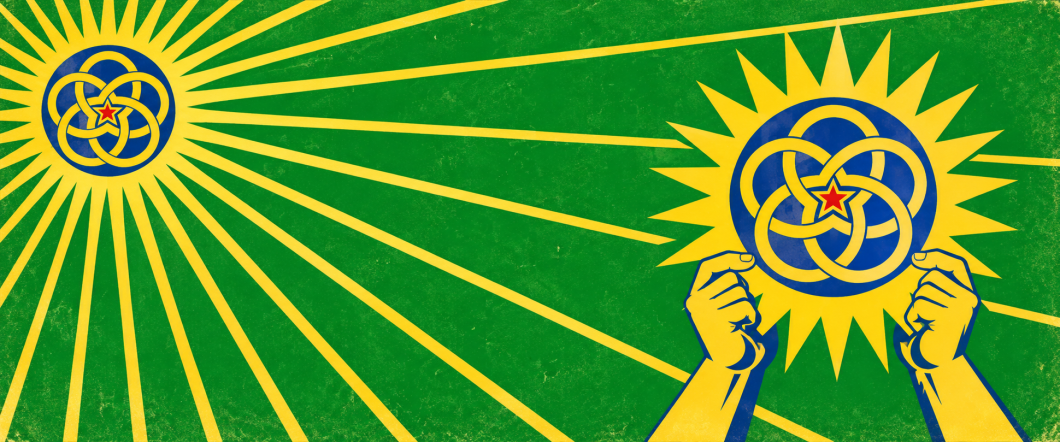
I have been thinking a lot about how genuinely social-revolutionary communalism, libertarian municipalism, and democratic confederalism actually are. They do not just ask for a kinder version of the present world. They ask us to imagine a society that exists after capitalism, after domination, after the centralized state, after hierarchy has stopped being treated as the natural structure of human life. They are difficult ideas partly because they ask people to think beyond the limits of what already exists.
A lot of political systems are called practical not because they are the most liberating, but because they remain close to the society people already know. Social democracy feels practical because capitalism is still there. Democratic socialism feels practical because the state is still there. Marxist-Leninist systems feel practical to some because the institutions of command, bureaucracy, centralization, and administration are still familiar. Even when ownership changes, the structure of domination often does not change enough. People may be given more material security, and that matters, but if they still do not possess meaningful power over the institutions governing their lives, then the transformation has stopped halfway.
That is the problem I keep returning to. We repeatedly reach the edge of liberation and then stop before crossing it.
Capitalism can be softened. Industries can be nationalized. Welfare can be expanded. Workers can receive more protection. Governments can become more responsive. Those changes can make life materially better, and I do not dismiss that. But none of those things automatically answer the deeper question: who actually holds power?
If the answer is still a centralized state, a party leadership, a bureaucracy, an owning class, or a professional political class, then domination has not disappeared. It has only changed its form.
That is why socialism, if it is going to deserve the name, has to be democratic. Socialism cannot simply mean that the state owns property. It cannot simply mean that a party administers the economy in the name of workers. Socialism means that the people themselves gain real power over production, land, housing, workplaces, resources, and the institutions shaping everyday life. Without democracy, socialism becomes administration. Without popular power, social ownership becomes state ownership. Without the ability to challenge, recall, deliberate, and decide, people remain subjects even when the government claims to rule on their behalf.
This is where the anti-state and anti-domination traditions become so important. The state concentrates political power in institutions standing above society. Capitalism concentrates economic power in the hands of owners. Patriarchy, racism, colonialism, ableism, and other hierarchies distribute power unequally through culture, law, property, and social institutions. A truly liberatory politics has to confront all of them.
It is not enough to replace the people sitting at the top. The structure that creates a top and a bottom has to change. That is why communalism feels so radical. Power has to return to people organized inside actual communities. People come together in assemblies. Those communities govern themselves. They coordinate through mandated and recallable delegates. Those municipalities confederate with other municipalities. The larger structure exists to coordinate the smaller democratic bodies rather than to rule over them. That creates an entirely different political order. It is democracy becoming the structure of society itself. And I think that frightens people precisely because it is so different from what they have been taught politics must look like.
A lot of people have never experienced real security or control over their own lives. Capitalism keeps people in survival mode. People are constantly worried about what happens next. When people live like that, it makes sense that they reach for the nearest imaginable solution. Usually that means a more humane form of capitalism.
Social democracy says capitalism can remain, but some of its sharpest edges can be restrained through public services, labor protections, taxation, and welfare. That can improve lives enormously. But it still leaves the major structures of private ownership and capitalist accumulation intact.
Democratic socialism goes further by demanding social ownership and democratic control of the economy. That is a much larger step toward liberation. But if democratic socialism remains trapped inside a highly centralized state, it can still reproduce political hierarchy even while challenging economic hierarchy.
Marxism-Leninism goes in another direction entirely. It may abolish or greatly restrict private capitalist ownership, but only ever creates State capitalism, and historically it has often transferred power into a centralized party-state. Workers may no longer answer to private capitalists in the same way, but they can end up answering to ministries, party officials, security institutions, and bureaucratic managers.
That is not the abolition of domination. It is a new arrangement of domination. People may have their needs met more reliably in certain areas, but if those needs depend upon staying within the acceptable boundaries established by the party, then liberation remains conditional. A person is not truly free merely because a ruler is kinder than the previous ruler. Freedom means not needing a ruler.
This is where anarchism made one of its greatest contributions. Anarchism understood that domination itself was the problem. It understood that hierarchy could not simply be used as a neutral instrument and then expected to disappear. It understood that states, classes, patriarchies, churches, corporations, armies, and bureaucracies could reproduce domination even when they claimed to exist for noble purposes.
That insight pushed revolutionary thought further. But anarchism also reaches its own questions. That is where I see anarcho-communism and anarcho-syndicalism as very close to the liberatory direction. They break much more sharply from capitalism and hierarchy. They recognize collective ownership, mutual aid, worker control, and decentralized organization. But they can still place too much emphasis on the workplace as the central political unit. Human beings are not only workers. We are neighbors, parents, caregivers, elders, disabled people, children, artists, students, patients, community members, and ecological beings.
A free society cannot be organized only through workplaces because not everybody’s most important relationship to society is employment. The community has to become political again. That is where communalism goes further. The municipality becomes the democratic arena where people meet not primarily as workers or consumers, but as citizens and community members.
The workplace can be democratized. The economy can be socialized. But those institutions exist within a wider democratic community that decides how resources should serve the common good.
Then those communities confederate. That is the point where anarchist insights begin transforming into something else. Communalism, libertarian municipalism, and democratic confederalism inherit anarchism’s opposition to domination, but they place much greater emphasis on building political institutions capable of sustaining freedom. That is why I do not understand them as simply another flavor of anarchism. They feel more like what happens when anti-authoritarian thought continues developing until it begins answering the institutional questions that pure negation cannot answer.
A revolutionary politics cannot only know how to dismantle. It has to know how to build. And this is why authoritarian and totalitarian systems actually travel in the opposite direction from liberation. They reproduce what I think of as domination realism: the assumption that somebody must ultimately stand above everybody else.
The fascist says the nation, leader, race, or state must command. The authoritarian communist says the party or revolutionary state must command. The capitalist says the owner must command. The technocrat says the expert must command. Different justifications. Same basic structure. Someone rules. Someone obeys. Someone decides. Someone is decided for.
Communalism rejects that structure itself. It means those things must be subordinated to democracy rather than transformed into a permanent ruling position. There is also a historical progression here that I find useful, even though history is never perfectly linear.
Classical liberalism was socially revolutionary in its own context because it challenged monarchy, aristocracy, feudal privilege, and religious domination. Ideas like freedom of conscience, individual rights, constitutional government, and equality before the law represented enormous ruptures with older hierarchical systems. But liberalism stopped.
Political equality was declared while economic inequality remained. Formal freedom existed alongside wage dependence, colonialism, slavery, patriarchy, and concentrated property.
Social democracy pushed further by recognizing that political rights mean very little when people are starving, sick, homeless, or powerless at work.
Democratic socialism pushes further again by asking why economic power itself should remain privately concentrated.
Anarchism pushes even further by asking why domination should remain anywhere at all.
And communalism, libertarian municipalism, and democratic confederalism take that anti-authoritarian insight and try to give it an institutional form that can actually reproduce itself across generations.
That is why we can imagine a kind of philosophical movement from liberalism, to social democracy, to democratic socialism, to anarchism, and then toward communalism and democratic confederalism. But because every stage asks a deeper question about domination. And I think progressivism itself has this problem. You remain progressive only as long as you remain willing to continue.
The moment you decide that some hierarchy is now permanent, some domination is now necessary, some class deserves authority, or some institution can no longer be questioned, you have found your stopping point. The liberatory impulse keeps going. It keeps asking whether the people themselves possess power. It keeps asking whether domination has actually disappeared or merely changed uniforms. There have always been partial forms of these ideas.
African communal traditions have emphasized shared land, mutual responsibility, kinship, reciprocity, and collective life. Many Indigenous societies developed decentralized political systems based on councils, consensus, confederation, reciprocity, and stewardship long before Europeans developed modern socialist vocabulary.
Certain strands of Christian social teaching emphasized the dignity of the poor, common responsibility, opposition to wealth worship, mutual care, and the moral danger of domination.
Peasant communes, village assemblies, worker councils, revolutionary municipalities, mutual-aid societies, cooperatives, and federations have appeared again and again throughout history. People have repeatedly discovered pieces of the same truth. Human beings can govern themselves together. What feels different now is that we possess centuries of political experience allowing us to see the patterns much more clearly.
We have watched liberalism defeat feudalism and then coexist with capitalism. We have watched “socialist” movements challenge capitalism and then reproduce State capitalism through domination.
We have watched anarchists expose hierarchy while struggling with questions of durable large-scale organization.
We have watched ecological destruction reveal that liberation cannot concern human beings alone.
All of this history gives us more material to work with. That is why communalism feels less like an arbitrary ideology and more like an attempt to gather the unfinished lessons of previous struggles. The goal is not merely socialism. The goal is not merely anarchism. The goal is not merely decentralization. The goal is a liberatory society.
A society where economic life is organized around need rather than profit. A society where ecological stewardship replaces endless extraction. A society where communities actually govern themselves. A society where workplaces are democratic. A society where municipalities confederate without surrendering their autonomy to a centralized ruling class. A society where people have enough material security to participate meaningfully in public life. A society where difference does not become hierarchy. A society where institutions exist, but nobody owns political power as a permanent possession. That is the destination.
Communalism, libertarian municipalism, and democratic confederalism matter because they are not satisfied with changing who rules. They ask whether ruling and being ruled should remain the basic structure of society at all. That is the rupture. That is what makes them genuinely social-revolutionary. And that is why I keep coming back to the same conclusion: every politics that sincerely follows liberation to its furthest consequences eventually has to confront the question of democratic communal power. Because the final measure of liberation is not how revolutionary a government calls itself. It is whether the people themselves have become powerful enough that they no longer need masters.

Lexi The Wulf
Occult Practitioner | Black | Nonbinary | Genderfluid | They/Them | Wolf Therian | Pan | Viadescioism

