
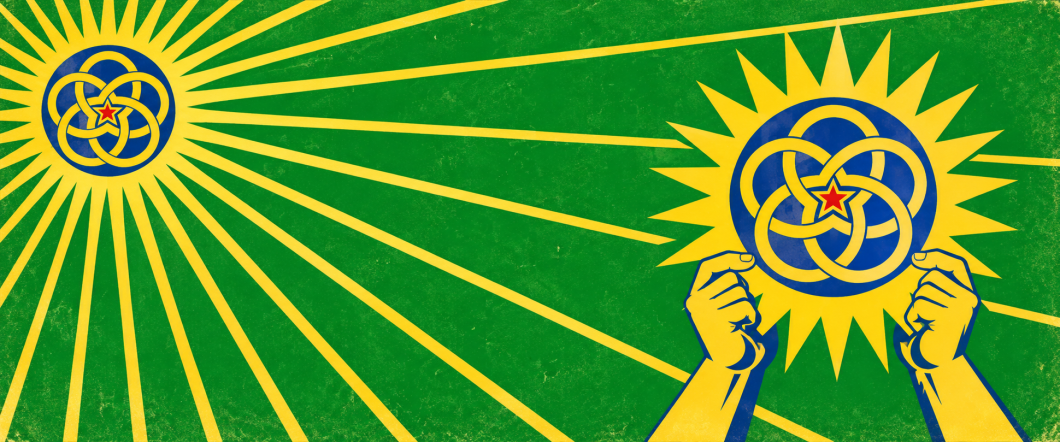
I think spirituality and religion have to be taken seriously in any truly liberatory society, because human beings do not live only through economics, law, and politics. We also live through meaning, ritual, grief, awe, memory, mystery, death, hope, belonging, and the question of what our lives are for. A communalist, libertarian municipalist, and democratic confederalist society cannot simply inherit the old secular assumption that religion is something private, embarrassing, irrational, or destined to disappear. At the same time, it cannot allow any religion to dominate public life or force everyone into a single spiritual paradigm. Liberation means neither theocracy nor compulsory atheism. It means building a genuinely pluralistic and post-secular society where many spiritual and nonreligious ways of understanding existence can live together without one becoming sovereign over the others.
Post-secularism matters because modern societies never actually became as secular as some people imagined. Religion did not simply vanish, and neither did spiritual longing. What changed was that many people stopped trusting old religious institutions while still needing meaning, transcendence, ritual, moral community, and some way of understanding their relationship to existence. A liberatory society has to recognize that instead of pretending everyone will eventually become a rationalist atheist. People will remain Christian, Muslim, Jewish, Hindu, Buddhist, pagan, Indigenous, mystical, humanist, atheist, agnostic, Viadescioist, and many other things. The political question is not which one wins. The political question is how all of them can share a common world without domination.
Classical liberalism did something important when it separated church authority from political authority, but it often treated religion as something that should simply be pushed into private life. I do not think that is enough. Spirituality is communal. People gather, mourn, celebrate, sing, pray, meditate, perform rituals, care for the dead, welcome children, mark seasons, and build moral relationships together. Those things do not stop mattering because the state declares itself secular. The better answer is not to remove religion from community life, but to remove religious supremacy from political power.
That means a democratic assembly should never belong to one religion, but religious people should not have to amputate their spirituality before entering it either. A Christian should be able to say that their faith calls them toward care for the poor. A Muslim should be able to speak from an ethic of mercy and justice. A Buddhist should be able to speak from compassion and nonattachment. A humanist should be able to speak from human dignity without believing in any divine reality. A Viadescioist should be able to speak about reciprocity, Emanations, Oxakna, and the sacredness of relation. What matters politically is that nobody gets to say, “Because my revelation says this, everybody else must obey.”
That is where multicultural pluralism becomes more than tolerance. Tolerance still implies that one group is normal and merely allows others to exist. Pluralism means society actually belongs to many traditions at once. Different communities can have temples, churches, mosques, shrines, meditation centers, sacred groves, humanist halls, communal rituals, and festivals, while the shared civic structure remains democratic and nonsectarian. The public realm does not become spiritually empty. It becomes spiritually open.
There are already traditions that point toward this kind of religious future. Unitarian Universalism is important because it has developed a strong commitment to pluralism, conscience, human dignity, and the idea that people can seek truth through many paths rather than being forced into one creed. The Baháʼí Faith is interesting because of its emphasis on the unity of humanity, the harmony of religions, and the overcoming of racial and national division. Universalist currents more broadly are important because they refuse the idea that salvation, truth, or divine concern belongs only to one tribe. These traditions are not perfect, and no religion should be treated as politically infallible, but they show that religion does not have to mean exclusivism, hierarchy, or theocracy.
Theism itself also has to be understood more broadly than many people understand it now. A lot of people can only imagine two options: either there is a separate supernatural ruler outside the universe, or there is nothing spiritual at all. That is the prison created by latent Christianity and latent atheism. Even people who reject Christianity often keep the Christian-shaped question. They ask whether there is a personal creator “up there,” and if they reject that image, they assume they have rejected spirituality itself.
But spirituality can be understood completely differently.
Emanationism gives one such path. Instead of imagining existence as something made from outside by a distant ruler, emanationism understands reality as unfolding from a deeper divine totality. The many emerge from the one without becoming completely separate from it. Divinity is expressed through existence rather than standing entirely apart from existence.
Non-dualism goes even further by challenging the assumption that sacred and ordinary, self and world, divine and material, are completely separate categories. It does not necessarily mean everything is literally identical. It means the boundaries we imagine as absolute may actually exist inside a deeper unity.
This is close to how I understand Oxakna and the Emanations. Oxakna is not simply a supernatural monarch sitting outside reality. Oxakna is the divine totality, the depth and whole of being. The Emanations are the countless expressions through which existence unfolds. Life, consciousness, matter, relation, transformation, beauty, destruction, creation, and community can all be understood as participating in that unfolding.
Reciprocity then becomes the spiritual ethic.
If existence is relational, then nothing truly flourishes alone. I receive from others, and I owe something back. I receive from the earth, and I owe care to the earth. I receive language from generations before me, and I owe knowledge to those who come after me. I receive food from ecosystems, labor from communities, care from other beings, and meaning from relationships. Spirituality becomes the practice of recognizing those relationships and responding to them responsibly.
That has enormous political consequences.
If I believe being is relational, then capitalism becomes spiritually deformed because it teaches us to treat relationships as transactions.
If I believe reciprocity is sacred, then exploitation becomes more than economic injustice. It becomes a violation of relationship.
If I believe the Emanations express sacred plurality, then racism, patriarchy, queerphobia, religious supremacy, and colonialism become attempts to dominate forms of existence that should be allowed to unfold freely.
If I believe divinity is encountered through the living world, then ecological destruction becomes a spiritual wound as well as a material one.
This is why spirituality belongs naturally inside social ecology.
Social ecology says that domination of nature grows out of domination among human beings. A spiritual social ecology adds that our separation from nature is also a crisis of meaning. Capitalism teaches people to see a forest as timber, a river as a resource, an animal as a commodity, land as real estate, and even human attention as something to monetize. A post-secular liberatory society has to restore the ability to encounter the world as meaningful, beautiful, relational, and worthy of reverence without requiring everyone to interpret that sacredness through the same theology.
The liberatory society would therefore be neither religious nor anti-religious in the old sense. It would be spiritually plural.
Some communities might hold seasonal celebrations around ecological cycles. Some might maintain ancient religious festivals. Some might create new civic rituals around harvest, remembrance, democratic participation, mutual aid, or restoration of the land. Some people would pray. Some would meditate. Some would sing. Some would perform offerings. Some would simply gather in silence. Some would understand all of this symbolically rather than metaphysically.
The important thing is that the community would make room for depth.
Because a society concerned only with production and administration can still become spiritually dead even if it calls itself socialist.
That is another reason authoritarian socialism was never enough. Marxist-Leninist systems often treated religion primarily as backwardness, superstition, or political competition. Instead of liberating spiritual life from hierarchy, they often tried to subordinate it to the state or remove it from public life. That reproduces domination in another form. A government telling people they are forbidden to worship is no more liberatory than a government telling people they are required to worship.
Freedom of conscience has to mean both.
You can believe.
You can doubt.
You can change.
You can combine traditions.
You can leave a religion.
You can form a new one.
You can be mystical without being theistic.
You can be atheist without becoming hostile to the spiritual lives of others.
You can participate in communal rituals without accepting every metaphysical interpretation behind them.
That is what a mature pluralistic society looks like.
The deeper problem is that both latent Christianity and latent atheism often reproduce the same narrow map. One says there is one correct supernatural order and everyone should ultimately recognize it. The other says that because this particular supernatural order is unconvincing, spirituality itself must be discarded. Both remain trapped in the same argument.
A post-secular society steps outside that argument.
It asks different questions.
What forms of spiritual life help people become more compassionate, grounded, courageous, reciprocal, and free?
What forms create domination?
What practices deepen community?
What beliefs justify hierarchy?
What rituals help people grieve?
What spiritualities strengthen ecological responsibility?
What kinds of religious organization allow people to participate without surrendering conscience?
Those are much more useful questions than simply asking whether “religion is good” or “religion is bad.”
The communalist principle is simple: spiritual communities should govern themselves internally so long as they do not violate the freedom and dignity of their members or others, and they should participate in wider civic life as equals rather than rulers. Religious institutions should not own political authority. Political institutions should not own the human soul.
That balance is essential.
A liberatory society that abolishes capitalism but suppresses spirituality is incomplete.
A liberatory society that builds assemblies but allows religious patriarchy to dominate households is incomplete.
A liberatory society that protects religious freedom but permits one faith to control law is incomplete.
A liberatory society that talks about pluralism but treats atheism as the only respectable worldview is incomplete.
Liberation has to reach all the way into how people understand themselves, one another, nature, death, meaning, and the sacred.
That is why I see post-secularism as part of the same historical movement as communalism, social ecology, and democratic confederalism. We are trying to move beyond domination in every form, including domination over meaning itself.
The future should not force everyone into one spiritual language.
It should create the conditions where many languages of meaning can coexist, meet, influence one another, and grow.
The liberatory society is not spiritually empty.
It is spiritually abundant.

Lexi The Wulf
Occult Practitioner | Black | Nonbinary | Genderfluid | They/Them | Wolf Therian | Pan | Viadescioism

